How Much Money Do You Need to Retire in India After 20 Years?
Estimate retirement savings needed in India after 20 years considering inflation and lifestyle.
Mar 06, 2026
Wealth


Blockchain is no longer just a buzzword connected to cryptocurrencies. It is becoming a foundation for how modern financial systems are built, managed, and secured. At its core, blockchain changes one simple idea: instead of trusting institutions blindly, people trust transparent systems. In finance, this shift is powerful because money is built on trust more than technology.
Traditional financial systems depend on banks, clearing houses, and intermediaries to verify transactions and maintain records. Blockchain introduces a shared digital ledger where transactions are recorded openly, securely, and permanently. Once data is written, it cannot be changed without consensus. This creates a new form of trust — not human trust, but system trust.
Blockchain is a decentralized digital ledger. Instead of one central authority controlling data, information is stored across many computers (nodes) connected in a network. Every transaction is verified, recorded, and linked to the previous one, forming a chain of blocks. This structure makes data extremely difficult to alter, creating security through transparency rather than secrecy.
In finance, this means records are not owned by a single institution. They are shared, verified, and protected collectively. This shift reduces dependency on centralized power and increases system integrity.
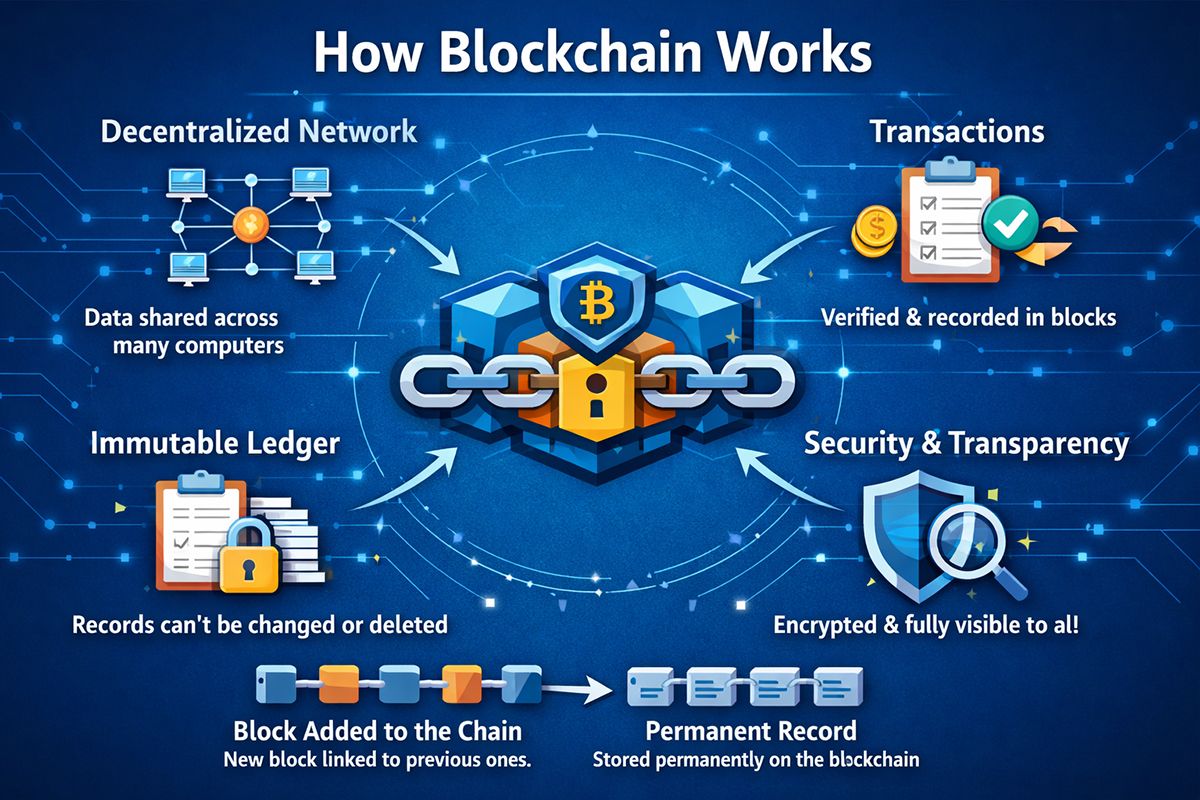
Financial systems today are complex, slow, and expensive. Cross-border payments take days. Settlements involve multiple intermediaries. Fraud, data manipulation, and inefficiency still exist despite advanced technology. Blockchain addresses these issues by removing unnecessary layers and replacing them with automated verification.
Blockchain reduces transaction time, lowers operational costs, and increases accountability. Every transaction becomes traceable and auditable in real time. This transparency creates trust between parties who do not know each other.
One of the strongest financial applications of blockchain is digital payments. Blockchain enables peer-to-peer transfers without traditional banks. This creates faster settlements, lower fees, and global accessibility. People can send value across borders with minimal friction, removing delays and currency barriers.
This is especially powerful in regions where access to banking is limited. Blockchain allows financial inclusion without building expensive physical infrastructure.
Smart contracts are self-executing digital agreements built on blockchain. When conditions are met, actions happen automatically without human intervention. In finance, this means loans, insurance claims, payments, and agreements can be automated.
This reduces human error, corruption, delays, and administrative costs. Smart contracts bring logic and automation into financial systems, making processes more efficient and reliable.
When trust becomes digital, systems become stronger.
Blockchain’s structure creates natural security. Data is encrypted, distributed, and verified by multiple nodes. There is no single point of failure. This makes hacking, fraud, and manipulation extremely difficult.
Transparency also changes behavior. When transactions are visible and traceable, accountability increases. This builds confidence not just in systems, but in institutions that adopt blockchain technology.
Banks and financial institutions are adopting blockchain for settlements, record-keeping, identity verification, and compliance. Investment platforms use blockchain for tokenization, allowing real-world assets like property, gold, and shares to be represented digitally.
This creates new liquidity, accessibility, and investment opportunities. Small investors gain access to markets that were previously limited to large institutions.
Decentralized Finance (DeFi) removes centralized control entirely. It allows people to lend, borrow, invest, and earn without traditional banks. Financial services become software-driven instead of institution-driven.
This creates a new financial model where users control assets directly. DeFi represents a shift from permission-based finance to open finance.
Blockchain is powerful, but not perfect. Scalability, regulation, energy consumption, and user education remain challenges. Financial systems require stability, and rapid technological change must be managed carefully.
Adoption must be balanced with regulation, security, and ethical responsibility. Blockchain is a tool, not a solution to every financial problem.
The future of finance will not be fully decentralized or fully centralized — it will be hybrid. Traditional institutions will integrate blockchain while decentralized systems continue growing independently.
Blockchain will not replace finance — it will reshape it. Systems will become faster, fairer, more transparent, and more accessible. Trust will move from institutions to infrastructure.
Blockchain in finance is not about cryptocurrency alone. It is about rebuilding trust, improving systems, and creating financial structures that serve people instead of controlling them.
Estimate retirement savings needed in India after 20 years considering inflation and lifestyle.

A simple money rule to balance spending, saving, and enjoying life.

Gold is a stable, long-term investment for wealth protection and security.

Simple habits to organize money, reduce stress, and build long-term financial stability.

Moringa offers powerful nutrition, health benefits, versatile uses, but also potential side effects.

Simple natural remedies help eliminate cockroaches safely and keep homes clean and pest-free.

Vitamin C supports immunity, skin health, and healing while preventing deficiency-related health issues.